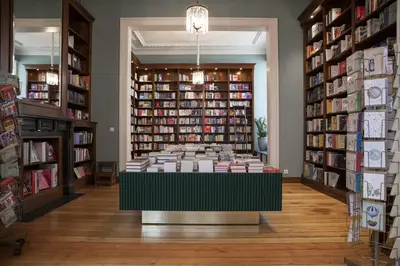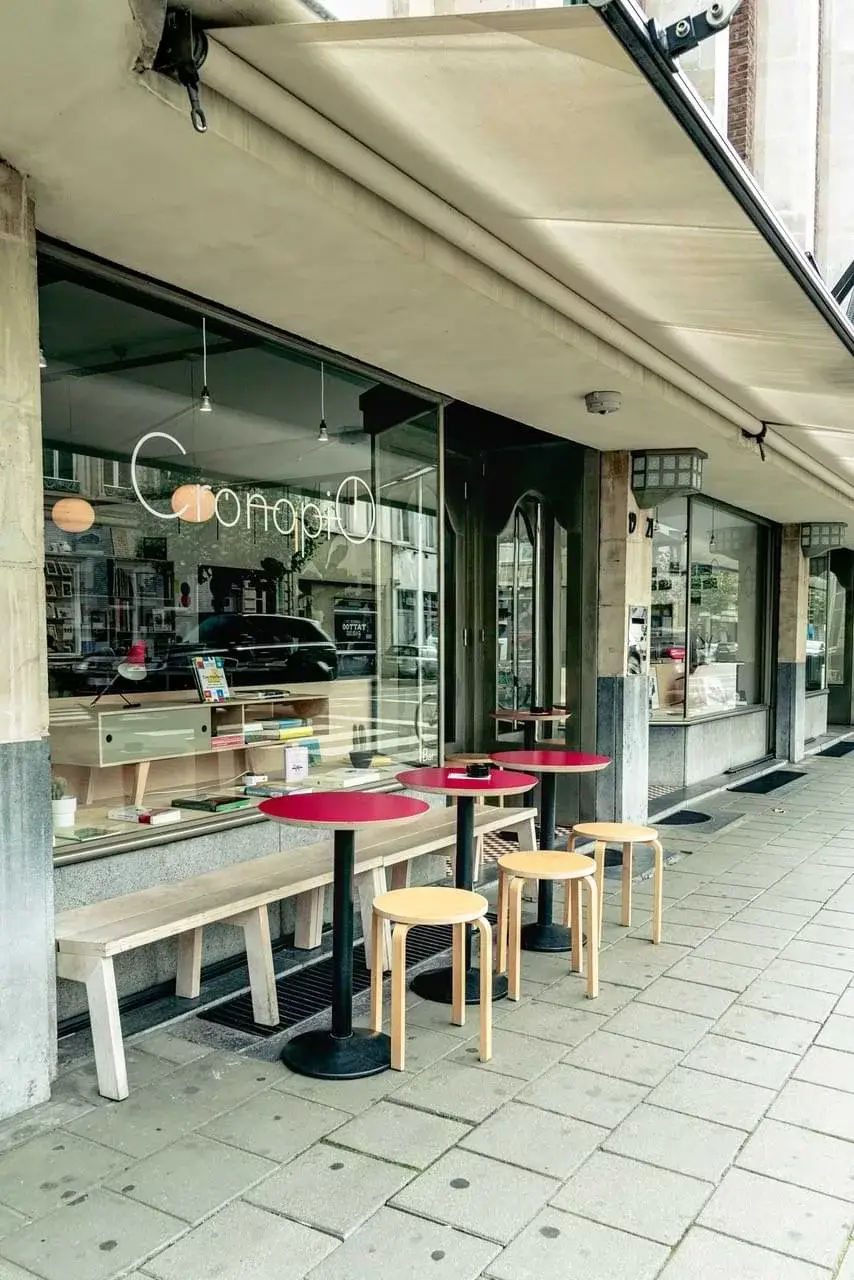
CronopiO is a bookshop with a coffee bar at Kasteelpleinstraat 21, on the Zuid. It sells literature in four languages, Dutch, English, Spanish and French, chosen, as the reading platform Antwerpen Leest puts it, for people who like to browse. With the books come coffee, wine and cake. The idea is simple: order a drink and something sweet, open the book you have just picked up, and start.
The name, with its capital O at the end, comes from a writer who was born in Belgium and left before he could read. That story is worth telling properly, because the earlier version of this page did not.

A writer born in Ixelles
Julio Cortázar was born on 26 August 1914 in Ixelles, in Brussels, where his father was attached to the Argentine diplomatic service. German troops were occupying Belgium at the time, and the family soon left for neutral Zürich, where his grandparents were waiting. Geneva and a short spell in Barcelona followed, and by the end of 1919 the Cortázars had settled outside Buenos Aires. He came back to Europe in 1951, to France, and stayed for the rest of his life, writing most of his major books in Paris or in Saignon, in the south. François Mitterrand granted him French nationality around 1981. He died in Paris on 12 February 1984 and is buried in the Montparnasse cemetery.
His best-known novel is Rayuela, Hopscotch in English, from 1963. A year earlier he had published Historias de cronopios y de famas, a book of short, playful sketches whose last section is given over to three kinds of people. The cronopios are naive, idealistic, disorganised, unconventional and sensitive. The famas are rigid, orderly and quick to judge, though they mean well. The esperanzas are plain, idle and dull. Cortázar called the stories a kind of game and said that writing them gave him great joy.
Green globes in a Paris theatre
The word itself arrived before the book. Cortázar first used it in 1952, in an article for the magazine Buenos Aires Literaria about a Louis Armstrong concert in Paris, under the headline "Louis, enormísimo cronopio". He later said the word had come to him some time before that concert, in the Théâtre des Champs-Élysées, as a vision of small green globes floating around the nearly empty hall. In one early story he describes the creatures as "those greenish, frizzly, wet objects"; their human habits came later, he wrote to his translator Paul Blackburn, as he wrote more stories about them.
The word escaped the book. Cronopio became an affectionate title among Cortázar's friends: the English edition of his novel 62: A Model Kit is dedicated to "Cronopio" Paul Blackburn, and admirers called Cortázar himself the Cronopio Mayor. A fossil mammal found in Argentina was named Cronopio dentiacutus. A bookshop in Antwerp is in good company.
It is also the right name for a bookshop, and better than most. An independent shop that mixes four languages lives off customers who come in for one thing and leave with another, which is to say off cronopios; the famas, who know exactly what they want, order it online. Naming the shop after the first group is honest about who keeps it open.
A district drawn on a citadel
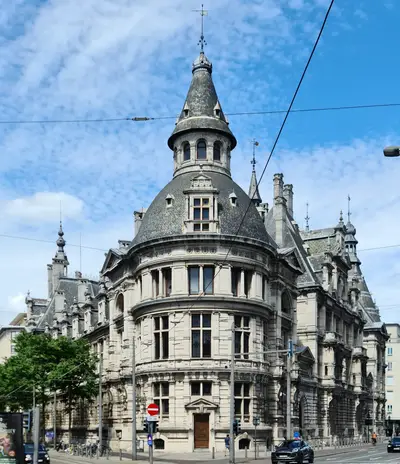
The Zuid, where CronopiO trades, did not grow; it was planned. The Spanish citadel that guarded the south of the city, known locally as the Zuidkasteel, came down from 1874, and a royal decree fixed the new street plan in 1875. The Royal Museum of Fine Arts followed in 1890 and the Zuid station in 1898, and until the Second World War the district, nicknamed Le Petit Paris, was a sought-after place to live.
Then came the long decline. The station closed and was demolished in 1965, and the southern docks were filled in and turned into car parks in 1968 and 1969. Anny De Decker ran her Wide White Space gallery on the corner of Schildersstraat and Plaatsnijdersstraat from 1966 to 1976, but interest in the district as a whole only returned after the Rubens Year of 1977, and the revival proper began in the mid-1980s. A photography museum opened in 2004 and the Palace of Justice, by the Richard Rogers Partnership, in 2007 on the old station site. The Circulair Zuid project is planned to add 2,200 homes between 2018 and 2030. Elsewhere on the Zuid, Vitrin on Marnixplaats has been pouring spritzes since 2011.
The shop
The listings agree on the basics: books in Dutch, English and Spanish, with French added by Antwerpen Leest; coffee, wine and cake; and a place to sit down with what you have bought. Bookcafes, a directory of bookshops with cafés, files it under book clubs, reading and working, and Tripadvisor lists it among the city's coffee and tea spots, which is half the story. CronopiO's own website has the shop's contact details and address; the telephone number listed for it is 03 226 68 94.
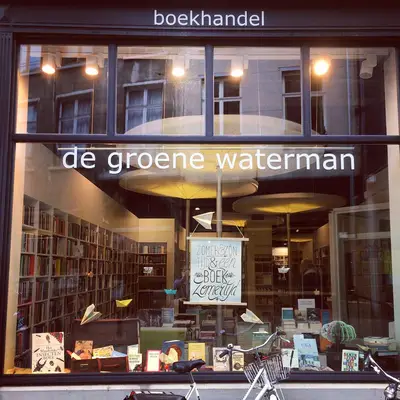
Antwerp has other independent booksellers, among them De Groene Waterman, another independent bookshop in the city. CronopiO's distinctions are the bar and the Spanish shelf. A shop named after a Brussels-born Argentine is the natural place in Antwerp to ask for Cortázar in the original.
An earlier version of this page described worn tiled floors, a dimly lit reading nook, a section for local authors, school partnerships and evenings of poetry with live music. None of it could be confirmed, so none of it is here. What can be confirmed is shorter and better: four languages, a bar, and a name with a story.
Cortázar left Belgium before he was old enough to read. Antwerp has made up for it.