
In the early hours of 19 March 1863, François-Xavier de Beukelaer, a student of medicine and pharmacy, finished the recipe for a yellow herbal liqueur he called Elixir d’Anvers. It is still made in Antwerp, at Haantjeslei 132, in a distillery that opened in 1894 and is now a protected monument down to its copper stills. VRT calls it the oldest registered brand name in Belgium. The recipe has never been written down.
According to VRT, for more than a century only the De Beukelaers knew the formula, passed on by word of mouth. In July 2026 Emile de Beukelaer, the founder’s great-grandson, who led the distillery for many years, celebrated his 100th birthday on the premises. Asked by VRT about his long life, he credited his wife’s optimism and not taking too many pills, and added: “I still drink a little elixir very regularly.”


From Bredastraat to Haantjeslei
The business moved several times before it settled. It began on Paardenmarkt, went quickly to 22 Bredastraat, kept offices at 77 Kipdorp and then took a larger distillery on the corner of Everdystraat and Hospitaalstraat. In 1894 De Beukelaer bought land on Haantjeslei, with a small castle and a park, and built a modern factory there. A warehouse at 40 Van Trierstraat followed in 1913. Before the First World War the company made about 700,000 litres a year and employed 60 to 80 people.
The medals came early. The company showed the elixir at the Antwerp International Exhibition of 1885, and a diploma from Boulogne-sur-Mer in 1887 carries the signature of Louis Pasteur. In the 1920s the drink was recommended for listless women, stressed men, sluggish horses and Babar, an elephant at Antwerp Zoo, whose vets had struggled to treat him. After three bottles he was said to be back to his old self.



A family, then another family
François-Xavier incorporated the firm in 1909, with his wife and his sons Emile and Louis-Xavier as shareholders, and died in 1917. Emile died of influenza in 1922. Louis-Xavier ran the company with his sons Balthazar-Xavier and Jean and Emile’s son Edmond until 1941, when he retired after 53 years. Balthazar-Xavier was killed when a V2 rocket hit his home during the Second World War, and Edmond took full control after it. In 1956 the company bought a second liqueur, Elixir de Spa, together with its royal warrant. When Edmond died in 1969, his son Emile took over.
Emile found no successor in his own family. In 1998 Ivan Nolet de Brauwere, from an old distilling family, became chief executive, and in 2008, when Emile left the board, the Nolet de Brauwere family bought the company. The earlier version of this article said a fifth generation of De Beukelaers was in charge. The company has been in Nolet hands for 18 years.
Today the day-to-day manager is Carl-Ivan Nolet, who told VRT that his family has distilled since 1691 and that he is its 11th generation. He says the takeover changed nothing in production, with the same stills and the same barrels. “We make Elixir d’Anvers exactly as it was made 163 years ago,” he said in July 2026.

Thirty-two herbs and five months
The method is public even if the recipe is not. Thirty-two herbs and spices from around the world, among them cinnamon, saffron and star anise, soak in pure alcohol in a copper pot still for about 24 hours. The still is then heated slowly with steam, and the vapour carries the aromas up into a distillate the distillers call alcolate. That is blended with more alcohol, soft water and beet sugar and left to mature in old oak casks for at least five months. The result is bottled at 36.9 per cent, in an octagonal bottle with a label in the Belgian tricolour and the arms of the province.
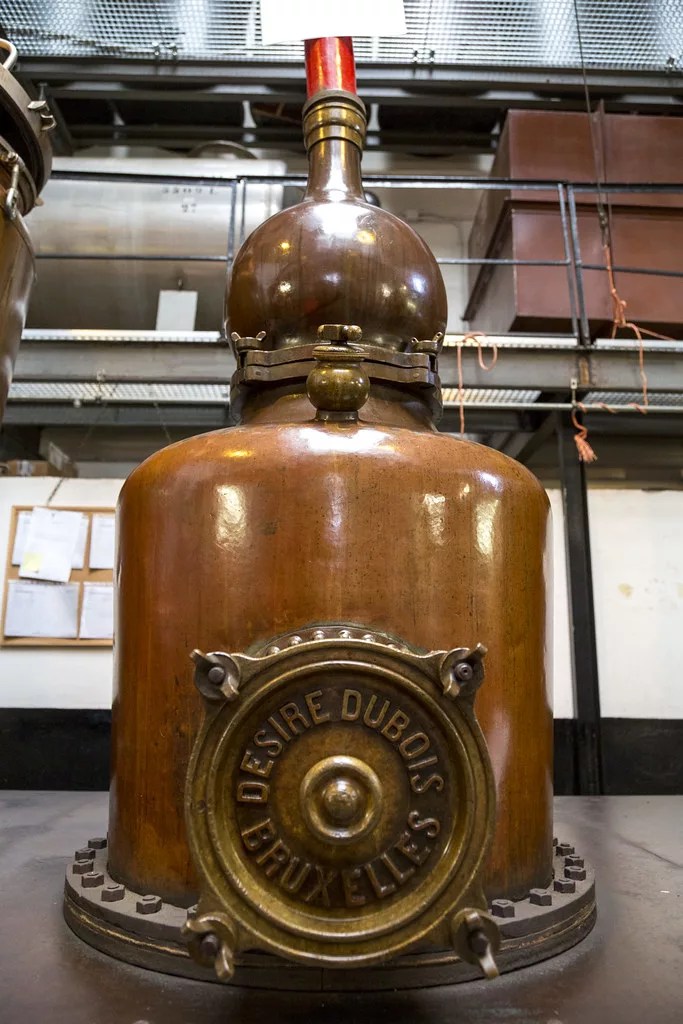
The equipment is the reason the building matters. The Flemish government listed the distillery provisionally in September 2018 and definitively on 12 March 2019, and the decision protects not just the architecture but four stills of 355, 803, 1,029 and 1,100 litres, the copper mixing vessels, the oak maturing vats and a steam boiler made by Jacques Piedboeuf in Jupille. The factory was designed by Jules Hofman, who drew it in the neo-Flemish Renaissance style in 1894 and later became one of Antwerp’s leading Art Nouveau architects. The neo-Flemish Renaissance director’s office is protected too.
Protecting the stills along with the walls was the right decision, because a listed distillery without its copper would be a museum of a factory, and this one still works. A food writer who visited compared the modest set-up to that of Sipsmith, the London gin distillery.


Half a million bottles
The numbers are those of a regional brand that has stayed regional. Sales run to nearly half a million bottles a year, mostly in Belgium and the neighbouring countries. In 2014 turnover was €3m; after an increase in excise duty sales fell by 12 per cent, and the staff went from 12 in 2014 to eight in 2016. Alongside the elixir and Elixir de Spa, the range now includes an Elixir d’Anvers advocaat, a Reserve and an Espresso version, in bottles from 3cl to 150cl.
How people drink it has changed more than how it is made. The house tradition was a few drops on a sugar cube, given even to children. Carl-Ivan Nolet points to the Antwerp Mule, Elixir d’Anvers with lime juice and ginger beer, and the company’s own recipe list runs from a Bee’s Knees to a milkshake. In 2026 Antwerp’s mayor, Els van Doesburg, called it part of the city’s identity and “real heritage”.


The distillery can be visited by groups of 20 to 50 people on working days, by appointment, with tours starting at 09:30, 10:00 or 13:30. A professional guide takes about two and a half hours, beginning in the director’s office and ending with a tasting of Elixir d’Anvers, Elixir de Spa and the house advocaat. Booking is through the Elixir d’Anvers website, where the distillery takes group bookings. The company’s old motto was Uti, non abuti: use, do not abuse.
Elixir d’Anvers (FX de Beukelaer)
- Address: Haantjeslei 132, 2018 Antwerp
- Founded: 1863; on Haantjeslei since 1894; protected monument since 2019
- Who runs it: the Nolet de Brauwere family, owners since 2008; manager Carl-Ivan Nolet
- The drink: 32 herbs and spices, 36.9 per cent, matured in oak for at least five months
- Visits: groups of 20 to 50, working days, by appointment, about 2.5 hours with a tasting
- Why it works: the recipe, the stills and the building have all stayed put
