
The Schipperskwartier, the skippers’ quarter, lies close to the old port, north of Antwerp’s historic centre, and the city first told its prostitutes where to work more than six centuries ago. The historian Floris Prims dates the arrangement to 1403, when Antwerp restricted them to the Guldenberg, beside the Scheldt.
For most of its history it was a sailors’ district first. In the late 19th century it had 84 lodging houses for sailors and dockworkers. Domien Sleeckx set his novel In ‘t Schipperskwartier there in 1861, and in 1953 Edith Kiel made a film comedy of the same name.
The bad decades
In the second half of the 20th century Greek bars, cafés and nightclubs opened in the quarter. In the 1980s women arrived to work in the windows from the Philippines, the Dominican Republic, Brazil and Africa, and after 1989 from eastern Europe. By the 1990s Antwerp had more than 240 windows, most of them spread over seventeen streets in the Schipperskwartier, and about 4,000 cars drove through the area every night. Trafficking, organised crime and violence grew with the trade.
Fiction has kept that period in view. Chika Unigwe‘s novel On Black Sisters Street, published in Dutch as Fata Morgana in 2007 and in English in 2009, follows four migrant women on the Zwartezusterstraat who are working to pay back the Nigerian pimp who brought them to Belgium. It won the Nigeria Prize for Literature in 2012, worth $100,000.
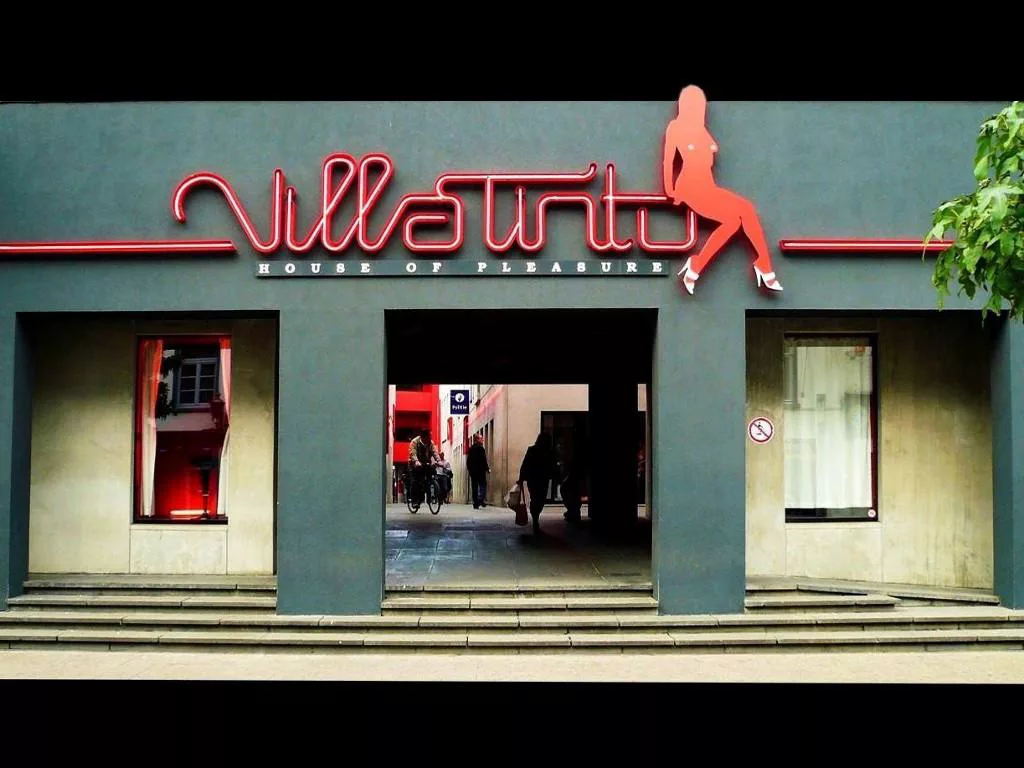
Three streets
The residents forced the change. In 1998 they petitioned the city council about prostitution and crime, and the council answered by drawing a line. Window prostitution was confined to a zone of tolerance, the triangle formed by the Schippersstraat, the Vingerlingstraat and the Verversrui. New rules set out to improve conditions for the women and to reduce the nuisance for everyone else; streets were pedestrianised, and more than €10 million went into regeneration. Over the 2000s Antwerp restructured the whole district and regulated it heavily.
Outside the triangle the quarter became an ordinary mixed neighbourhood, with social housing, upmarket lofts, cafés and restaurants. Nearby, the old docks of the Eilandje now hold the Museum aan de Stroom, the 60-metre museum by Neutelings Riedijk Architects that opened in 2011 on the Hanzestedenplaats.
National law has since caught up with the city. On 1 June 2022 Belgium decriminalised sex work, extending protection to the third parties who make it possible, such as banks and accountants. A labour law that took effect in December 2024 gave sex workers the same social rights as other employees: they can sign employment contracts and claim social security, and anyone who wants to employ them needs a clean criminal record and a licence.
The Amsterdam comparison
Amsterdam took the other road. Its De Wallen district has about 300 one-room cabins on some 6,500 square metres, and the city has spent years trying to shrink it: in September 2007 the council forced 51 windows to close, about a third of the total, and in 2008 mayor Job Cohen proposed closing half of the city’s 400. De Wallen also restricts access from one in the morning, Thursday to Sunday, with bars shut at two and brothels at three. In 2019 mayor Femke Halsema went further: “We must dare to think big, also about ending prostitution in the Red Light District.”
Antwerp’s containment is the better model. A fixed, regulated triangle of three streets gave the women rules that protect them and gave the rest of the quarter back to the people who live in it, which is what the residents of 1998 asked for. Closing windows one building at a time, as Amsterdam has tried, leaves the question of where the work goes unanswered.
The quarter has gone back to being material. In 2025 the Fakkeltheater premiered ‘t Schipperskwartier, a comedy by Dirk Van Vooren and Manu Jacobs. Sleeckx got there 164 years earlier.
The Schipperskwartier
- Where: by the old port, north of the historic centre
- On record since: 1403
- Red-light zone: Schippersstraat, Vingerlingstraat and Verversrui, since the reforms that followed the 1998 petition
- Windows: more than 240 in the 1990s
- Regeneration: more than €10 million
- Why it works: the city drew a line round the trade and gave the rest of the quarter back to its residents
