
The city of Antwerp asked its architect for a new theatre in 1827, and it got one with stage machinery made of wood and rope. The Bourla, on Komedieplaats, opened in 1834 with wooden beams, pulleys, ropes and levers filling the levels above and below its stage, and that rigging is still in the building. Few theatres can say that. Europa Nostra, the heritage federation, calls it the last municipal theatre in Europe with its original stage machinery.
The theatre carries the name of the man who drew it. Pierre Bruno Bourla was born in Paris in 1783 and served as Antwerp’s city architect from 1819 to 1861. He taught architecture at the Royal Academy of Fine Arts, whose entrance gate he also designed, renovated the town hall and worked on the restoration of the Cathedral of Our Lady, the city’s Gothic landmark. He was made a knight of the Order of Leopold in 1840 and died in Antwerp on the last day of 1866.


A French theatre on the Tapissierspand
Plays had been staged on the site since 1709. Bourla’s building went up on the ground of the old Tapissierspand, the hall where woven wall hangings were once traded, from 1829, and the Belgian Revolution of 1830 slowed the work. It opened in 1834 as the Théâtre Royal, run by a French company, and for its first hundred years it was a French-language house in a Dutch-speaking city. Only in 1933 did the French administration end and the Koninklijke Nederlandse Schouwburg, the Royal Dutch Theatre, move in. The building was listed as a protected monument in 1938.
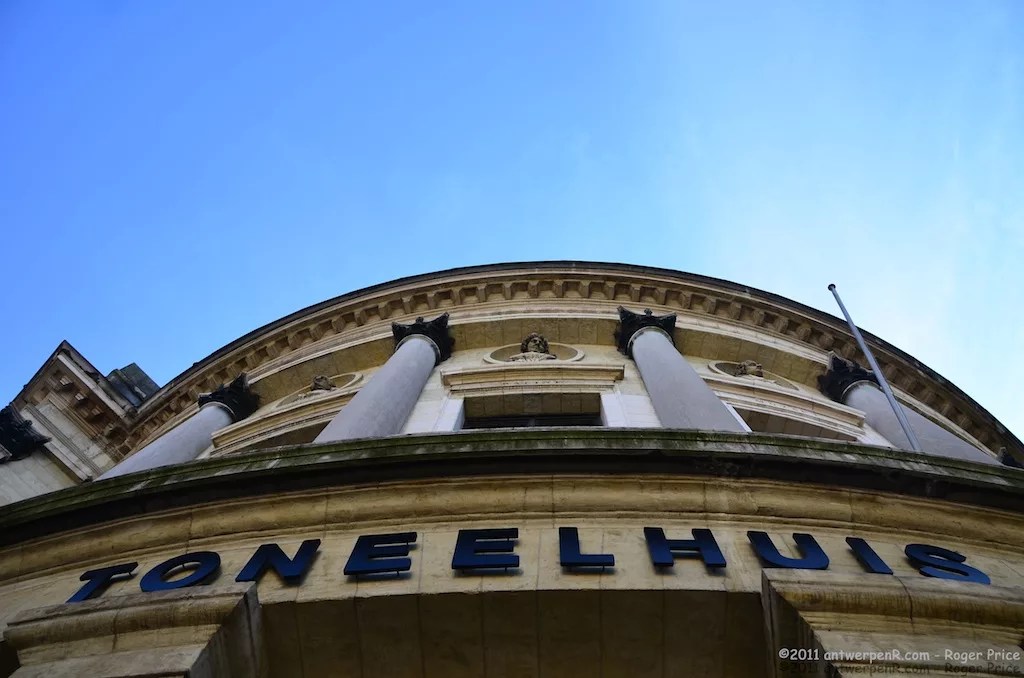
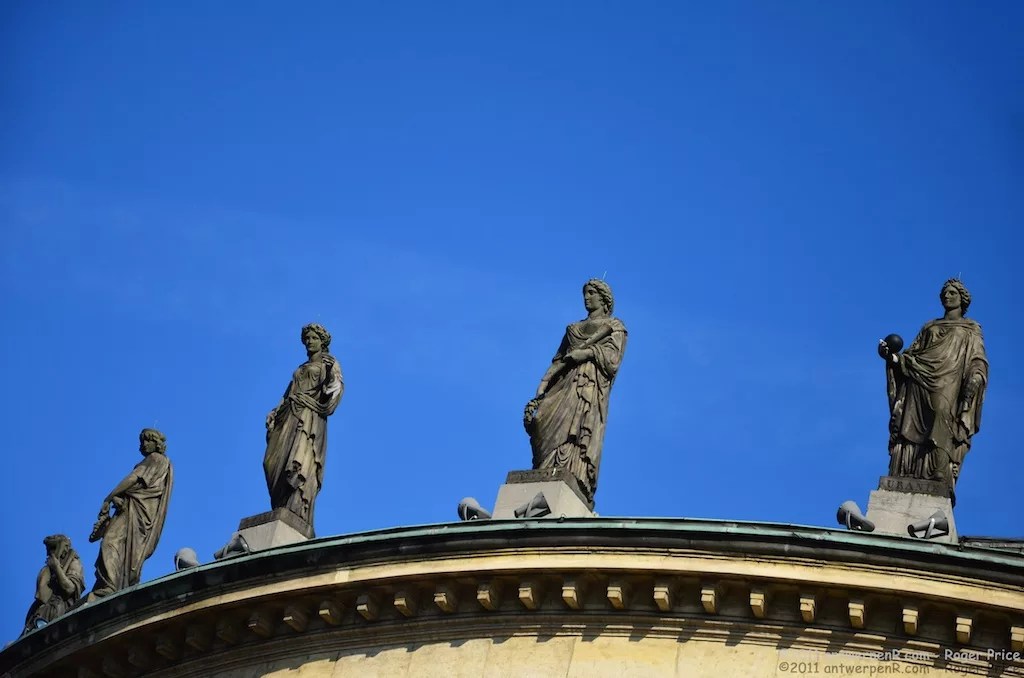
The facade is neoclassical and semicircular, with a row of columns. Apollo and the nine muses stand along the top, and busts of Molière, Shakespeare and Mozart are set into the front: a reading list for anyone queuing for tickets. Inside is a horseshoe-shaped auditorium in the Italian manner, with a parterre and tiers of boxes in red velvet and gilt. It seats about 900.

The hall has been changed more than once. In 1865 Bourla’s successor, Pieter Dens, enlarged the auditorium, added a balcony and built separate staircases so that working-class theatregoers could reach their seats without mixing with the middle classes. Early in the 20th century the side walls were moved outwards by about three metres, because the corridors and stairs had become too narrow for the crowds.
The machinery nobody wanted to use
The stage machinery was built by the French firm Philastre and Cambon, and it is the reason the Bourla matters beyond Antwerp. The earlier version of this article credited the theatre with a hydraulic stage; there are no hydraulics in it, only wooden beams, pulleys, ropes and levers. For most of its recent life the rigging was a problem rather than a treasure. The building closed in 1980 because it had fallen into disrepair, and its demolition was openly discussed. A renovation began in 1991 and the theatre reopened in 1994, and in 1998 the Royal Dutch Theatre merged with the Blauwe Maandag Compagnie to form Toneelhuis, the company that still plays there.


Toneelhuis never used the historic machinery, and it wanted it taken out to make room for modern equipment and storage. A feasibility study ordered by the city in 2013 agreed. The next year Europa Nostra and the European Investment Bank Institute put the rigging on their list of the seven most endangered heritage sites in Europe, and the argument turned. A masterplan by two London practices, DRDH Architects and Julian Harrap Architects, drawn up with the Flemish heritage agency and approved in 2016, keeps the 1834 rigging and links the upper stage to new computer-controlled machinery with as little change to the old mechanism as possible. Nabilla Ait Daouad, then the alderwoman for culture, described the compromise as one that preserves “the authentic theatre machinery”.
Keeping it is the right decision, because Europe has plenty of modern black-box theatres and only one municipal stage where you can still see how a scene change was done in 1834. The rest of the plan is practical: the sloping stage will be flattened and lowered, the original entrance doors in the side walls reopened, the salons and foyers opened to everyone, and the loading bays moved underground.
A curtain call, postponed twice
The price has risen with each announcement. In 2018 the city put €400,000 into the masterplan and estimated the whole project at about €70m. By May 2026 the estimate stood at €98m, with Flanders adding a further €10m in December 2025. The works were due to start in the summer of 2025, then in the summer of 2026, and are now planned for after the summer of 2027. They are expected to take about three years.

Each delay has bought the company another season. In April 2025 Toneelhuis renamed its farewell festival from Bye Bye Bourla to Stand Bye Bourla and stayed on. “It would be a shame to leave such an iconic hall empty for a year,” said Tom Dewispelaere, the actor who is its artistic director. In May 2026 Lien Van de Kelder, the alderwoman for culture, said the city did not want “to turn off the light earlier than necessary”.

This season Toneelhuis alternates between the Bourla and the small hall in the Kambala on the Eilandje, where its costume and set workshops are already based. That hall seats about 100. After the summer of 2027 it is to be rebuilt for about 400, and every Toneelhuis performance will move there until the Bourla reopens. The full programme for both stages is on the Toneelhuis website, with tickets for the Bourla and the Kambala.

The foyer without a ticket
You do not need to see a play to get inside. Café Foyer, on the first floor, has been open from Wednesday to Saturday at lunchtime and into the early evening. The Grand Foyer, with its painted ceiling, opens to the public on the first Sunday of the month for brunch. Guided tours of about two hours are offered from time to time, sometimes in Dutch, and they often sell out; the machinery is shown only on the special tours, not the standard ones.

The building is a 15-minute walk from Antwerp Central station, and the box office has kept short hours, from Wednesday to Friday in the afternoon. In 192 years, the machinery above the stage has outlasted the French company, the Royal Dutch Theatre and at least one plan to throw it away.

Bourla theatre
- Address: Komedieplaats 18, 2000 Antwerp
- Opened: 1834, designed in 1827 by city architect Pierre Bruno Bourla
- Who runs it: Toneelhuis, artistic director Tom Dewispelaere
- Seats: about 900
- Hours: Café Foyer Wednesday to Saturday, 12:00 to 20:00; box office Wednesday to Friday, 13:00 to 17:00
- Renovation: €98m, due to start after summer 2027 and take about three years; Toneelhuis then plays at the Kambala on the Eilandje
- Getting there: 15 minutes on foot from Antwerp Central; nearest tram stop Oudaan
- Why it works: the city kept the 1834 rigging after its own study said to scrap it
