
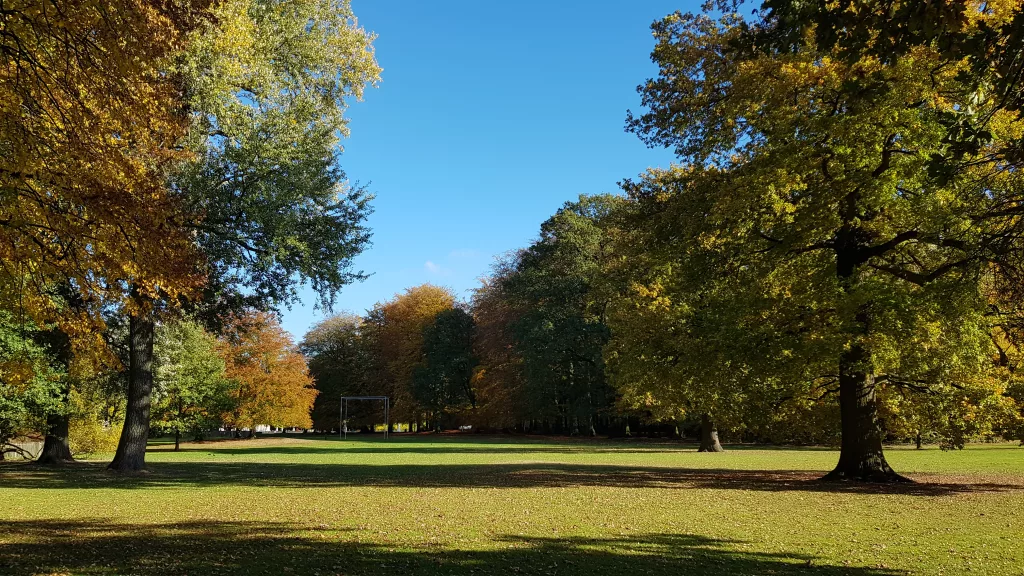
In 1921 the Province of Antwerp bought a country estate in Deurne to stop it being covered in houses, and two years later it opened the gates. The Rivierenhof was the first provincial park in Belgium. Today it covers about 132 hectares, which makes it the largest park in the city of Antwerp, and it draws more than a million visitors a year without charging any of them.
The size depends on who is measuring. The provincial domain’s own listings say 130 hectares, the Dutch encyclopaedia 132 and the Green Flag Award’s park register 135. Any of these figures is generous for a park that sits inside a city district, about six kilometres from the centre in Deurne, the district east of the old city.
Jesuits, bankers and a provincial clerk
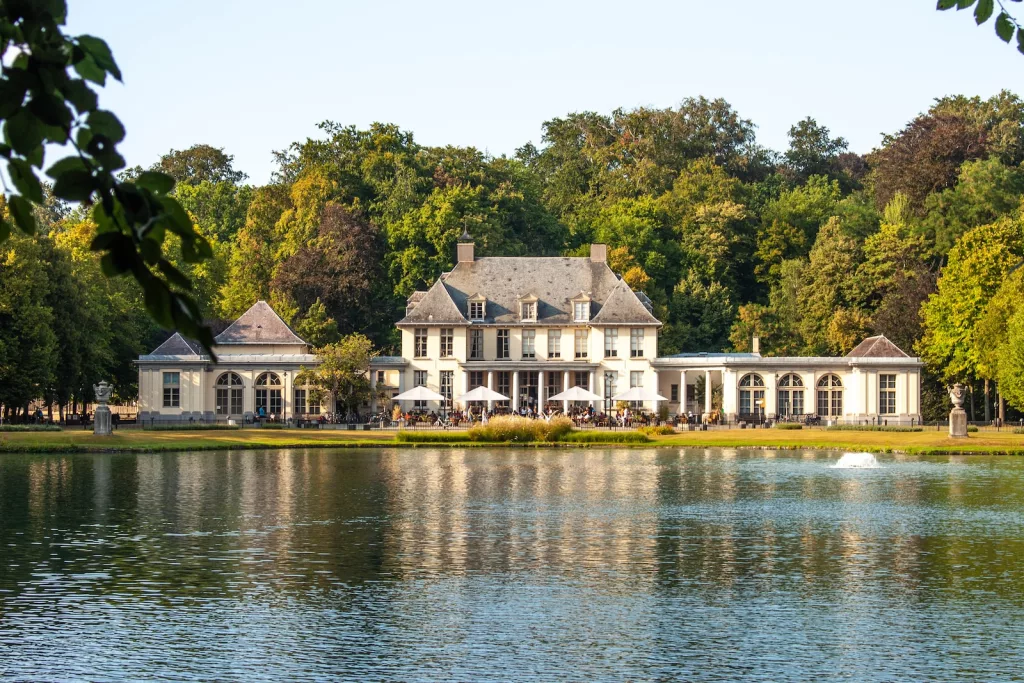
The estate began in the 16th century as a country house called ‘t Goed ter Rivieren, a name taken from the waters around it: the Schijn river, the ponds and the Herentalse Vaart canal. The merchant Magnus van Bullestrate added an orchard and a private brewery. From 1618 to 1773 the Jesuits owned it, and a stone dated 1735, a fragment of their Ignatius church in Antwerp, survives in the park. When the order was abolished, the estate went to auction, and in 1776 the banker Jan Baptist Cogels bought it, demolished the Jesuits’ house and built a neoclassical one in its place. The first version of this article gave the estate to the Mayer van den Bergh family. They never owned it.
The Cogels family held the land for more than a century. In 1889 it was sold at auction to Louisa Bosschaert-Cogels, and in 1921 the province bought it on the initiative of its clerk, J. Schobbens, whose bust now stands by the mirror pond. The park opened in 1923. In 1937 the Royal Flemish Dendrological Society was founded there, which says something about the trees.
Two castles
Kasteel Rivierenhof, the Cogels house, was protected as a monument in 1993 together with its entrance gate of 1741, the Jesuit gate. It now holds a café-restaurant, at Turnhoutsebaan 244.
Sterckshof, the second castle, is older and stranger. In the 13th century it was a moated farm called Hooftvunder, probably built to guard a wooden bridge over the Grote Schijn. In 1523 and 1524 the merchant and banker Gerard Sterck, an adviser to Emperor Charles V, bought it and began the castle that carries his name. By the 1880s it was a ruin. What stands today is largely a reconstruction from 1922 plans by the architect J.A. Van der Gucht, built with red-brick turrets from old pictures and archaeological finds. From 1938 it was a museum, and from 1994 to 2014 it housed the province’s silver museum, whose collection then moved to the DIVA museum in the city centre.
The province then offered Sterckshof for sale at €4.5m, and in 2017 the Flemish government approved €2m in subsidies for its renovation. By August 2019 no buyer had come forward. Selling it would be a mistake: the castle has been open to the public since 1938, and a castle inside a free public park should stay as public as the park.
Water, trees and a rose garden
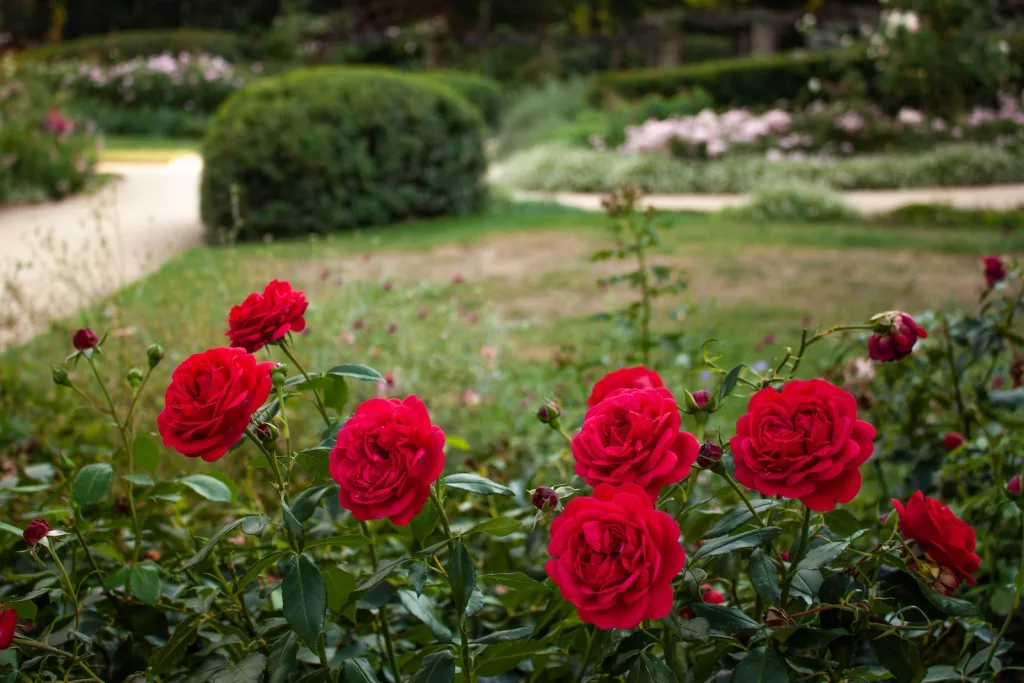
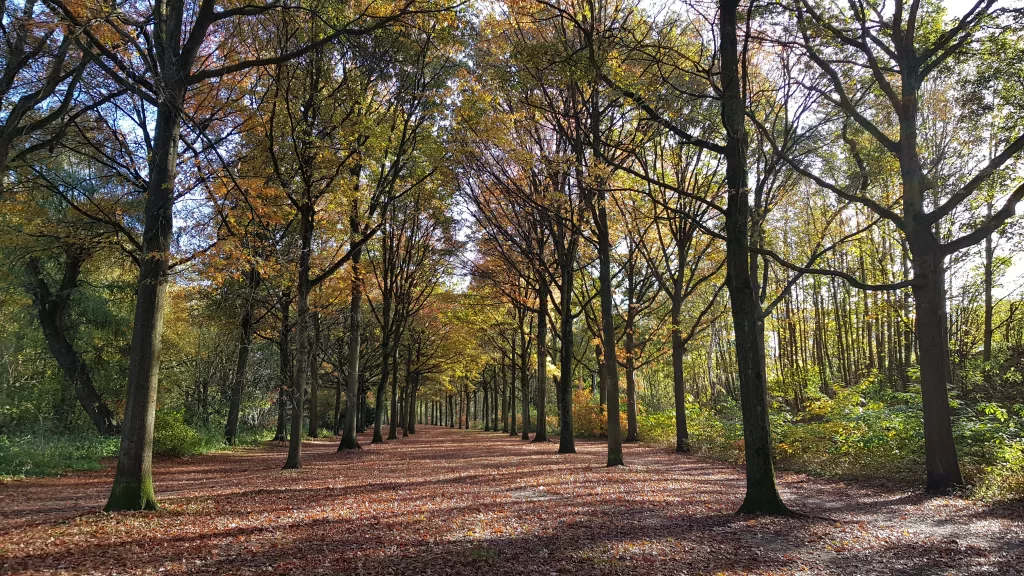
The Grote Schijn still winds through the park, and one of the last open stretches of the Herentalse Vaart runs inside it. Fishing is allowed in a 4-hectare fishing pond and a 2.2-hectare rowing pond, which hold perch, roach, bream, carp and pike-perch. There are six collection gardens: a rose garden, an arboretum, a pinetum, an azalea garden, a coryletum of hazels and a Celtic tree horoscope. Among the notable trees are two dawn redwoods and a ginkgo, and a summer lime on the Parkweg has been a protected monument since 2010.
The rest of the park is for doing things. There is a 10 km running course, football, tennis, korfball and pétanque, minigolf, a maze, playgrounds, a petting farm, a fairytale house for storytelling and a gallery for amateur artists. Inside the domain, a campus of the Sint-Godelieve school occupies art deco buildings from 1923 by Pol Berger. In the 1950s a motorway was built along the park’s edge.
The open-air theatre
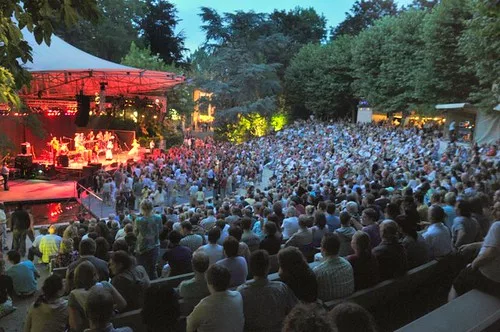
The Openluchttheater Rivierenhof, known as OLT, runs a summer programme of concerts. In 2025 it installed a new sound system to keep the volume down for the neighbours and for people walking in the park. Dieter Sermeus of OLT called it fairly unique and the first of its kind in Belgium for an open-air theatre. “We always try to create a strong experience without pushing the volume up unnecessarily,” he told VRT. The province and the theatre plan to renovate the old grandstand and replace the electrics next. The 2026 programme included two open-air nights by Goose, on 12 and 13 August.
Run like a large urban park
About 100 staff and 30 volunteers keep it going, and some 25,000 schoolchildren a year take part in its education programmes. Peter Verdyck, who has directed the park since 2004, has collected the paperwork that proves it: ISO 14001 environmental certification since 2013 and, in 2018, the first Green Flag Award given to a park in Belgium. “The Green Flag Award is important as a recognition that a park is properly managed,” he said in 2019.
In 2018 the World Urban Parks association also gave the Rivierenhof its Silver International Large Urban Parks Award at a ceremony in Melbourne. It was the only silver awarded. The gold awards went to Centennial Park in Sydney and Phoenix Park in Dublin, which is reasonable company for a former Jesuit estate in Deurne.
Opening hours, events and the summer programme are on the Province of Antwerp’s page for the Rivierenhof domain. Entry is free, and the bust of the clerk who arranged the purchase still stands by the pond.
Rivierenhof
- Address: Turnhoutsebaan 232, 2100 Deurne (Antwerp)
- Opened: 1923, bought by the province in 1921
- Who runs it: Province of Antwerp, Provinciale Groendomeinen Regio Antwerpen; director Peter Verdyck
- Size: about 132 hectares; more than a million visitors a year
- Hours: daily, 06:30 to 22:30
- Price: free entry
- Why it works: the province bought it to keep the houses out, and entry is still free
