
The Meir is 700 metres long and has been mostly car-free since 1993, the year Antwerp was European Capital of Culture. It was first mentioned in 1257, when it was marshland beside a lake just outside the city; the name comes from the Old Dutch meere. By the early 15th century it was a wide paved street with a canal down the middle, and in the first half of the 16th century the canal was covered over. Rich families then built mansions along it as the old centre grew crowded, and a new stock exchange nearby pulled the city’s trade on to the street.

At the turn of the 20th century the street was widened to lead towards the new Central Station, finished in 1905, and the festival hall and the domed Innovation department store went up along it. Today the trams run underneath, through the Meir premetro station at the western end, on lines 3, 5, 9 and 15, and the Rubens House sits just off the street, on the Wapper.
A palace and a festival hall
The palace on the Meir was built for a merchant. Johan-Alexander van Susteren, who made his fortune through the Ostend Company, had three buildings demolished in 1745 to make room for a city palace designed by Jan Pieter van Baurscheit the Younger. He died in 1764, before it was finished. Napoleon bought it, furniture included, in 1812 for 170,000 francs and had it divided into four apartments, but never stayed there. It passed to King William I and then to the Belgian royal family, who used it under Leopold I, Leopold II and Albert I, until King Baudouin gave it to the Ministry of Culture in 1969.
The heritage organisation Herita now runs the Paleis op de Meir, and in March 2025 relaunched its first floor, Hall of Mirrors included, as a venue for receptions and weddings. Jeroen Bryon of Herita called it a “mini-Versailles in the middle of the city”. The ground floor holds The Chocolate Line, the shop of chocolatier Dominique Persoone, and a draw in its own right. Further along, at Meir 85, the Osterrieth House is a rococo mansion of 1746.
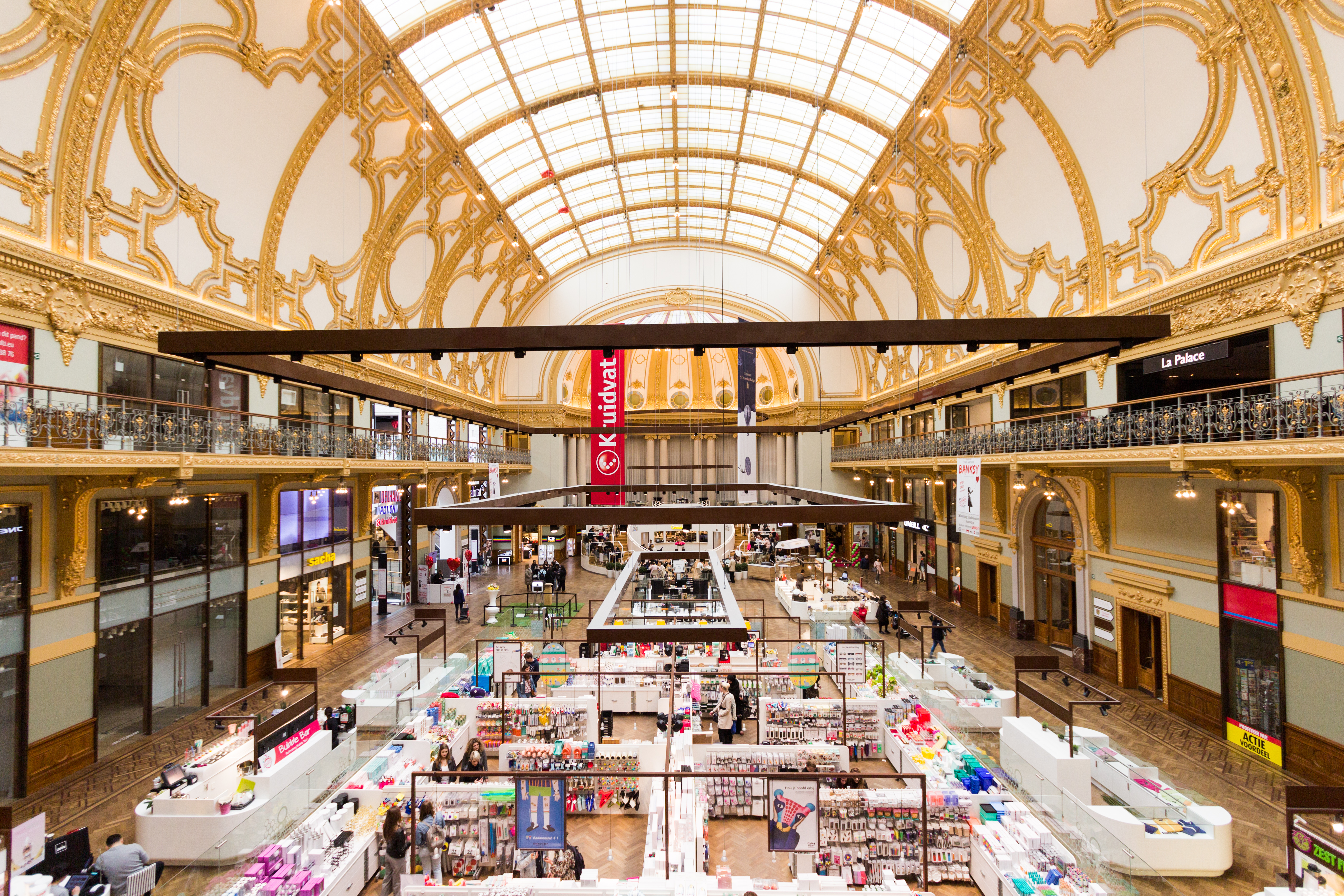
The Stadsfeestzaal opened in 1908 and burned on 27 December 2000, after a short circuit; the caretaker called the fire brigade shortly after five in the morning, and a Christmas gift fair lost its entire stock. Only the monumental staircases, the facade and the steel roof survived. Insurance and permits took about four years, rebuilding another three, and the authorities insisted on the 1908 details: “The same marble, the same wood,” says city guide Tanguy Ottomer, who is writing a book about the hall. “Otherwise rebuilding the Stadsfeestzaal would not have been allowed.” It reopened as a shopping centre in October 2007. In January 2025 Ablon Retail Real Estate, a company founded in Antwerp, announced that it had taken ownership. It will keep the protected building a shopping centre for now while it looks at what else it could be; at the time, the whole first floor was closed to the public.
What the rent says
The Meir has long topped Belgium’s shop-rent tables. In 2018 the property adviser Cushman & Wakefield put the top rate at €2,000 per square metre a year, ahead of Brussels’ Nieuwstraat at €1,850 and Ghent’s Veldstraat at €1,325. By 2022 the same firm’s figure had dropped to €1,550, still almost twelve times the €135 asked on the Boomsesteenweg, and it counted more than 1.4 million visitors a month. In February 2026 Jonathan Delguste of Cushman & Wakefield said the most prestigious Belgian streets, the Meir among them, had almost no empty units left.
The Meir is not the dearest address in Antwerp, though. A JLL study in 2018 found the smaller Schuttershofstraat and Huidevettersstraat more expensive per square metre than the Meir itself.

The biggest arrival is still under construction. On the Meir Corner, where the street meets the Jezusstraat on the site of the old Proximus building, Zara has leased 14,500 square metres over three floors for what will be its largest shop in the world. The Karel de Grote university college is building a campus in the same development. The building is due to be finished in the second half of 2026, with Zara opening a few months later. “Zara wants to open large shops in all major cities around the world,” said Nicolas Beausillon, chief executive of Tans Urban Landmarks. “Here they want to offer a unique shopping experience as a counterbalance to online shopping.”
The student campus is the better half of that deal. A shopping street that only fills on Saturdays needs people who are there on a Tuesday evening, and a college brings them every week of term.
Facade to facade
The street itself is next: it is in poor shape and the sewer underneath is out of date, so the city will rebuild the Meir together with the Leysstraat, the Jezusstraat and the Twaalfmaandenstraat. Five design teams showed their ideas in March 2025, with a public presentation in the Stadsfeestzaal. In May the city chose Sweco, BAU and the lighting designer Atelier Jéol, joined by the heritage consultants Erfgoed en Visie, and in February 2026 it approved their concept: one material from facade to facade, more and healthier trees, rainwater that soaks into the ground, and lighting that shows off the monuments. A preliminary design is due in autumn 2026, the final design in 2027, and work starts in 2028 at the earliest. “We are restoring Antwerp’s monumental shopping and walking axis,” said Ken Casier, the alderman for public space.
The shopkeepers are less sure about the trees. “Many trees and planters stand in the way of the stream of people who come to the Meir on shopping Saturdays,” said Karo Janssens of Beleef Antwerpen, the city’s retailers’ association, which also wants more bins, because planters without them turn into bins.
The trees are still under discussion. The sewer is not.
The Meir
- Length: 700 metres, car-free since 1993
- First mentioned: 1257
- Prime rent: €1,550 per square metre a year (Cushman & Wakefield, 2022)
- Visitors: more than 1.4 million a month (2022)
- Coming: the largest Zara in the world on the Meir Corner; street rebuild from 2028 at the earliest
- Getting there: premetro Meir, trams 3, 5, 9 and 15
- Why it works: 18th-century fronts above, Belgium’s top shop rents at street level, and the tram underneath
