
The Museum Mayer van den Bergh on Lange Gasthuisstraat closed its doors on 27 April 2025 and plans to open them again in 2029. For four years the museum is a building site, and its best-known painting, Pieter Bruegel the Elder‘s Dulle Griet, has moved a few doors down the same street. It is a good moment to explain what the house is, and why it is being taken apart to be put back as it was in 1904.

A collector and his mother
Fritz Mayer van den Bergh was born in Antwerp in 1858, the eldest son of Henriëtte Van den Bergh and Emil Mayer, a businessman from Cologne. He was trained for diplomacy and chose collecting instead, buying most intensively from 1897. His field was the art of the 14th to 16th centuries, which at the time was neither fashionable nor expensive. He died in 1901, aged 43, after a fall from his horse.


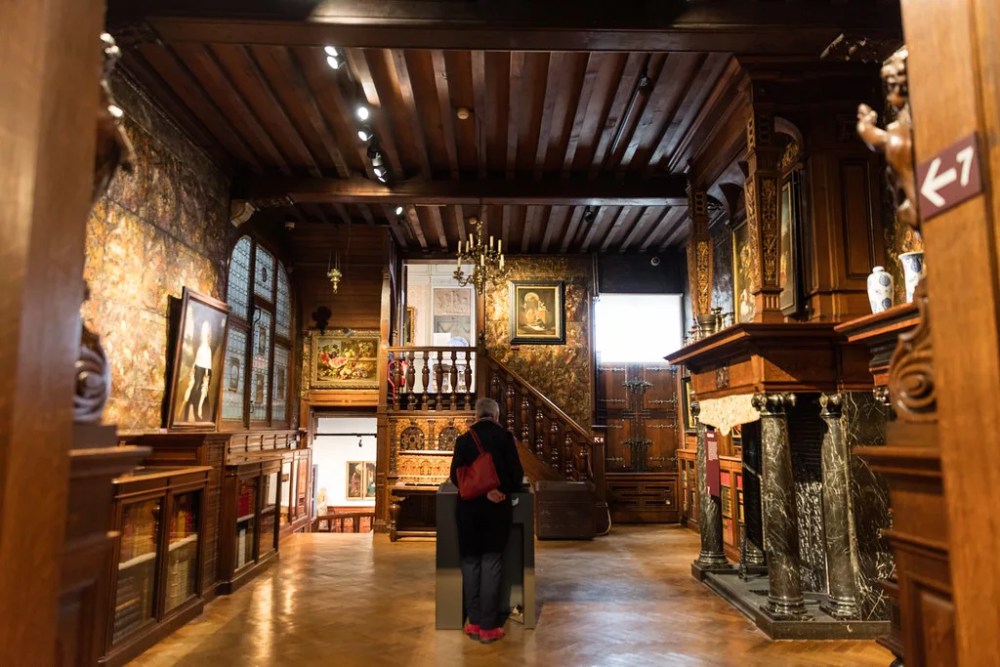
His mother finished what he had planned. Between 1901 and 1904 she had a museum built for his collection next to the family’s corner house, designed by the Antwerp architect Joseph Hertogs in a neo-Gothic manner to look like a 16th-century town house. It opened in 1904. Her will was blunt about what should happen next: the collection must stay exactly as Fritz assembled it, and “nothing can be removed or added”. She also set up a Board of Regents to watch over it. Since 1951 the board and the City of Antwerp have run the building and the collection together.


What he bought
The famous purchase is Dulle Griet, or Mad Meg, painted by Bruegel in 1561. The picture had been thought lost; Fritz bought it at an auction in Cologne in 1894 for 488 Belgian francs. The collection also holds Bruegel’s Proverbs and The Temptation of Saint Anthony by Pieter Huys, dated 1577. The quieter treasures are older. The Christ and Saint John group by Master Heinrich of Constance is a 14th-century carving, and the Mayer van den Bergh Breviary is an illuminated prayer book of 1,412 pages from the late 15th or early 16th century, probably made for a wealthy Portuguese merchant in Antwerp, with Gerard David and Simon Bening among its painters.
By the museum’s count Fritz collected more than 6,000 objects, coins and tokens among them, along with a gilded Brabant Christmas crib stand from the mid-15th century, Delftware, seals, jewellery and furniture. About 60 pieces are on the Flemish government’s list of top masterpieces.

The house next door
The renovation reunites the museum with the corner house where Fritz grew up. After the family, that building served as the district house, the local town hall of the Antwerp district, until 2021, and it now stands empty. The preliminary design, approved in 2024, restores it as a town palace where visits will begin, returns the 1904 museum as closely as possible to its original state and adds a new building at the back with a reception, a museum shop, rooms for temporary exhibitions, an education space and a semi-public courtyard. The design is by Happel Cornelisse Verhoeven Architecten, working with the British heritage practice of Julian Harrap. AG Vespa, the city’s property company, manages the works, which start in spring 2026 and run until 2028; then the new climate installation is tested before the collection moves back.
Director Carl Depauw was frank about the scale when the plan was announced. “Er worden echt serieuze ingrepen uitgevoerd,” he told VRT NWS: really serious interventions are being carried out. On the courtyard he was more modest: “Die was er al, maar is nu niet meer te zien.” It was always there; you just cannot see it now.
Closing for four years is the right decision. A museum whose founder forbade adding or removing a single object can only get better by improving the house around the collection, and that is exactly what the plan does. Thomas Leysen, chairman of the Board of Regents, put it in the terms Henriëtte would have recognised: “This expansion is fully worthy of the legacy of Henriëtte Mayer van den Bergh.”


Where to see it until 2029
Part of the collection is still on show, a short walk away. Public Favourites, at the Maagdenhuis at Lange Gasthuisstraat 33, opened on 20 June 2025 and runs until 12 September 2027. It shows 90 works, 22 of them on the masterpieces list, each chosen by one of 43 Antwerp museum lovers who explain why it moves them. Dulle Griet is there, with a new reading by the youth organisation Girls in the City. “This participatory project with Antwerp residents is unique,” said Lien Van de Kelder, the city’s alderwoman for culture. From late 2027, a selection goes to Paris for a project with the Musée de Cluny, the national museum of the Middle Ages, a fitting address for a collector who bought medieval art when it was out of fashion.
Antwerp has other museums that are houses first, the Rubens House, home to the painter’s studio and the Museum Plantin-Moretus, the printers’ house on Vrijdagmarkt among them. This is the one built as a house for a collection. The museum’s own website has tickets and news on the reopening.
Henriëtte’s will allowed nothing to be added. The architects are adding a building, and the chairman of her board calls it worthy of her.
Museum Mayer van den Bergh
- Address: Lange Gasthuisstraat 19, 2000 Antwerp (closed for renovation)
- Founded: built 1901 to 1904 by Henriëtte Mayer van den Bergh; opened 1904
- Who runs it: the Board of Regents and the City of Antwerp; director Carl Depauw
- Closed: since 27 April 2025; reopening planned for 2029
- Meanwhile: Public Favourites, Maagdenhuis, Lange Gasthuisstraat 33, until 12 September 2027, Tuesday to Sunday 10:00 to 17:00
- Architects of the extension: Happel Cornelisse Verhoeven Architecten with Julian Harrap
- Why it works: one man’s collection, kept as he left it, in a house built to hold it
